


A customer in the United States books your tour and pays in dollars. By the time that money reaches your account in euros or pounds, it's less than the price they paid. Between checkout and settlement, a chain of different payment parties takes a percentage in the form of foreign transaction, currency conversion and card network cross-border assessment fees. Across hundreds of international bookings, an unoptimized cross-border payment becomes a huge margin drain.
So, what actually happens behind the scenes? This article covers:
- What is a cross-border payment in travel?
- Who is involved in a cross-border payment?
- How cross-border payments work, step by step
- Common cross-border payment transfer methods
- The benefits and challenges of cross-border payments
- Why cross-border payments are often declined
- The difference between cross-border and local acquiring
Make sure to read part two, where we show you how to reduce costs and stay compliant when accepting cross-border payments.



Key Takeaways
- A cross-border payment moves money between people in different countries.
- A single card booking passes through several parties in the payment ecosystem, including the issuing bank and card networks.
- Travelers in different markets have different payment preferences. Accepting cards, digital wallets and offering local payment methods helps you get more bookings.
- Cross-border payments are declined more often than domestic ones because banks treat foreign payments as higher risk.
- Local acquiring is the most effective fix as it routes payments through an acquirer in the customer's country, reducing the number of declines.

What is a Cross-Border Payment in Travel?
A cross-border payment is a transaction where the payer and payee are in different countries. In the context of travel, cross-border payments are more complex than a standard cross-border retail purchase.
The customer and the travel provider are based in different countries, deal in different currencies, and the service is often delivered months after payment. A single booking can involve a customer in one country, a travel operator in another and a travel supplier in a third.
Who is Involved in a Cross-Border Payment?
Cross-border card payments rely on an ecosystem of financial institutions. Here's what each one is responsible for:
- The payment gateway securely captures the customer's payment details at checkout.
- Card networks carry the authorization and settlement messages between two banks.
- The issuing bank holds the customer's account and decides whether to approve the payment.
- The acquiring bank receives the funds on your behalf.
- The funds arrive in your merchant account.

How Cross-Border Payments Work
To your customer, a cross-border payment is simply accepted or declined. Behind the scenes, however, the cross-border payment process is far more complex. Let's look at an example of a cross-border card payment:
- The Payment is Initiated: The customer enters their card details at checkout and completes the booking in their own country and currency.
- The Request Reaches the Bank: The details pass through the encrypted payment gateway and the card network to the customer's issuing bank.
- The Bank Approves or Declines the Payment: The issuing bank checks funds are available and screens the payment for fraud, before approving or declining the payment. This process typically takes seconds, and an approval confirms the booking.
- The Currency is Converted: As the payment is processed, it's converted from your customer's currency into yours, at the current exchange rate.
- The Payment Settles: Your acquiring bank receives the funds and pays them into your merchant account.
- Fees are Deducted: Cross-border payment fees can include foreign transaction, currency conversion and card network cross-border assessment fees, which vary by financial institution and payment system. We cover this element of cross-border travel payments in more detail in part two of this series.
Common Cross-Border Payment Methods
The method your customer chooses determines how fast the money reaches you and what it costs. In the context of the travel sector, these are the most popular cross-border payment methods:
Card Payments
When a traveler makes a booking, they often reach for a credit or debit card. A 2024 Visa survey found that 62% of travelers used a credit or debit card to make a cross-border travel payment. To travelers, card payments are fast and easy and offer consumer protection in the form of fraud and dispute resolution.
Digital Wallets
Digital wallets like Apple Pay, Google Pay and PayPal are fast, secure and popular with tech-native consumers. Travel companies are keen to add this payment method to their stack because it results in fewer cart abandonments.
Local and Alternative Payment Methods
Travelers trust the payment methods they already use. If you're selling your services in the Netherlands, for example, make sure to offer iDEAL. For Chinese customers, offer Alipay or WeChat Pay. Support the popular option in each market and you'll lose fewer bookings.
Bank Transfers
Bank transfers work best for large, occasional payments such as overseas supplier payments. They move over the SWIFT network, so they're slower and you'll lose a portion of the booking's value to fees.
Cross-Border Payments: The Benefits and Challenges
Accepting international payments has its benefits and challenges for travel businesses:
The Benefits
- Sell to Travelers Anywhere: Accepting international payments means you stop turning away bookings from customers whose payment method or currency your setup couldn't handle. Every market you want to reach becomes one you can actually sell into.
- Fewer Abandoned Checkouts: Travelers are far more likely to complete a booking when they can pay in their own currency, using a payment method they trust. An unfamiliar currency and limited payment options are often all it takes for customers to close the checkout tab.
- More Approved Payments: With the right cross-border travel payments setup, you'll find that more of your international payments are approved.
- Easier Market Expansion: Once your cross-border payments setup is established, you'll find that many of the barriers that once blocked you from moving into new regions are gone. With the right travel merchant account partner offering local acquiring, you won't need to jump through all the hoops that previously slowed your growth.
The Challenges
- Higher Fraud Risk: International travel bookings are more exposed to fraud than domestic ones because they pair high-value, card-not-present payments with customers and cards from all over the world, making it easier for fraudsters to exploit vulnerabilities. A travel-specific fraud prevention and detection strategy using real-time monitoring and machine learning will help you identify and stop fraudulent payments.
- Currency Uncertainty: Exchange rates change between the moment a customer books and the moment the payment settles, so the amount you receive can differ from what you expected at the time of booking.
- Cross-Border Fees: Cross-border payments come with fees (like card network cross-border assessment fees) that eat into your already thin margins.
- More Declined Payments: Without the right cross-border payment infrastructure in place, you'll see an uptick in payment declines because financial institutions view foreign payments as high risk. Payment declines are one of the biggest drains on cross-border revenue, so optimizing your cross-border payments process is essential.
Why are Cross-Border Payments Declined?
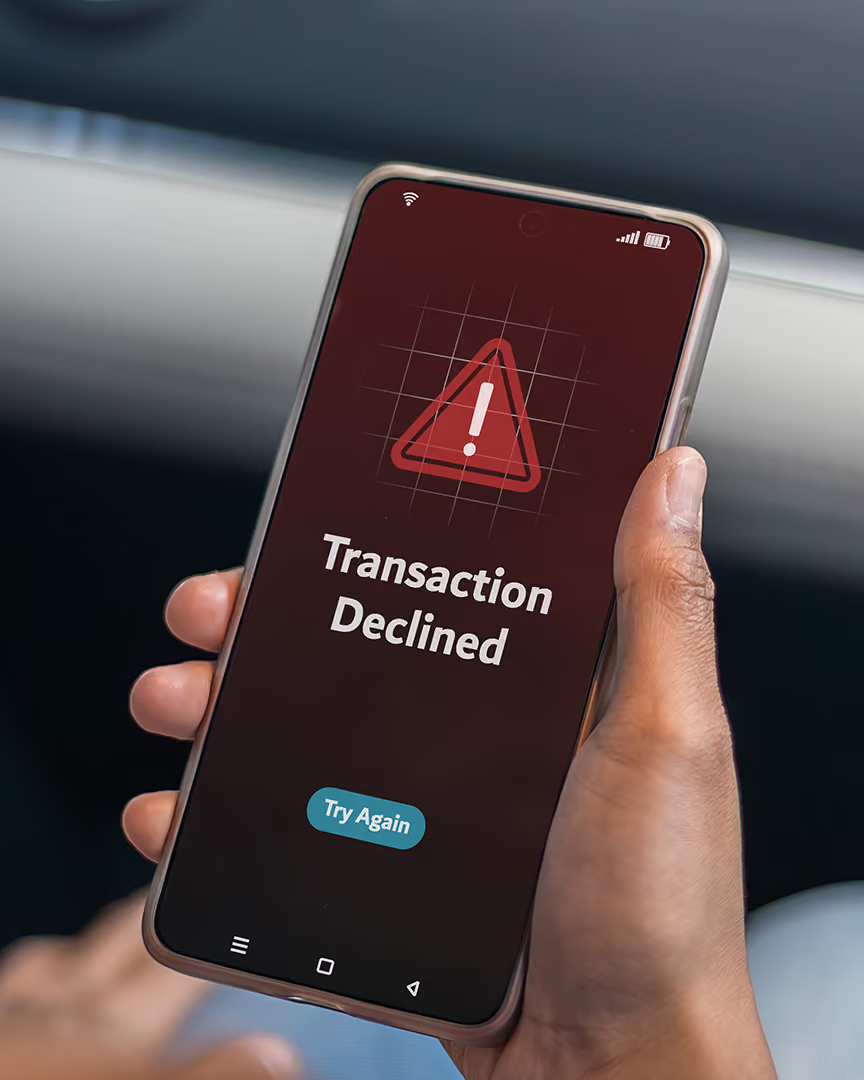
A big problem for travel operators is that a cross-border payment is far more likely to be declined than a domestic one. This is because, to the customer's bank, the payment carries more risk. It sees a charge heading to another country, in another currency and this makes the bank's fraud systems suspicious. The card's country, the payee's country and the payment currency can be viewed as a mismatch. Out of an abundance of caution, the bank may decide to decline the payment.
False declines cost businesses a lot of money. In the United States alone, false declines cost merchants approximately $118 billion a year. Each one is a booking you lost at the very last step, with travelers often taking the decline as a sign to look for travel services somewhere else.
What's the Difference Between Cross-Border and Local Acquiring?
One of the most effective ways to reduce payment declines is through local acquiring. Let's explore how it differs from cross-border acquiring:
Cross-Border Acquiring
With cross-border acquiring, you process payments from every market you sell in through a single acquirer in your home country. It seems appealing at first because it's relatively straightforward to set up, but it quickly creates problems. Because your acquirer is located in a different country to your customer, their bank views the payment as foreign and applies extra scrutiny that results in more payment declines.
Local Acquiring
Local acquiring, on the other hand, means payments are routed through an acquirer in the customer's country, so their bank views it as a domestic transaction and approves payments more often. However, without the right payment partner to guide you, it's a complex setup process.

Repayd Simplifies Cross-Border Payments
Cross-border payments are complex, but with the right support, you can optimize them to keep more from each booking. Repayd's travel merchant account is built around how travel payments actually work. We process payments locally in your customers' markets to boost approval rates and provide multi-currency payment acceptance, helping you build trust with your customers.
How cross-border payments work is only half of the story. In part two, we break down the costs and compliance side of cross-border payments.